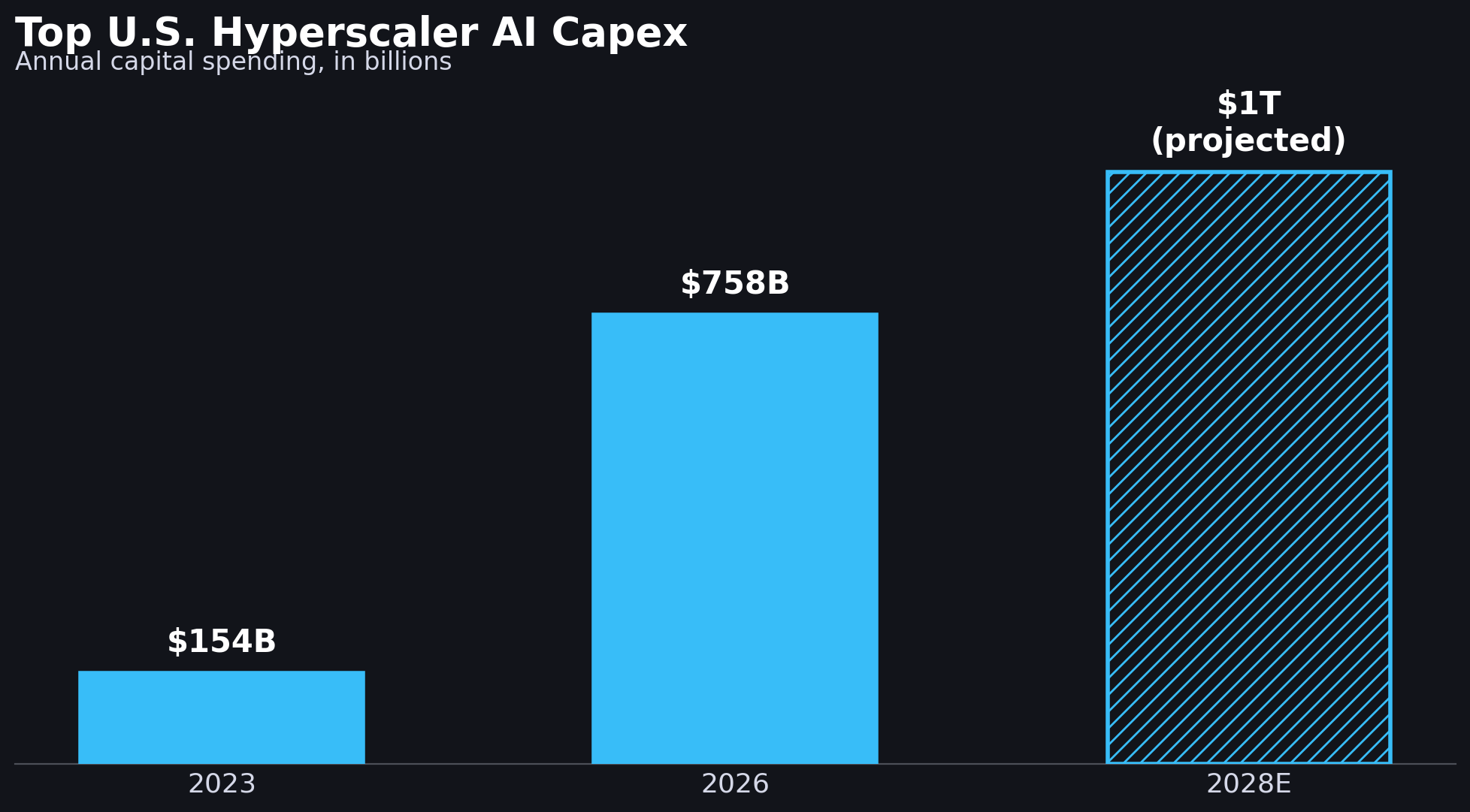
The five largest hyperscalers in the U.S. are on track to spend $758 billion on AI infrastructure in 2026, and that number is headed toward a trillion dollars by 2028. I spent a couple hours recently walking a room through why that figure matters more than any headline debating whether AI is a bubble, and I want to break down the core of that argument here.
The Spending Is the Story, Not the Stock Price
Most people judge AI by scrolling headlines or by using ChatGPT to draft an email. That's the wrong lens. To figure out whether this is a bubble or the start of a new economic era, you look at what the biggest companies in the world are actually building and whether real demand exists behind it. Amazon, Microsoft, Alphabet and Meta spent $154 billion combined on this in 2023. This year alone, those same companies are spending $758 billion, up 74% from last summer. That's not marketing spend. That's purchase orders flowing through hundreds of companies that make chips, memory, and grid equipment.
Why This Looks Like Railroads and Electricity, Not Dot-Coms
We've seen this shape of cycle before. Every major infrastructure buildout follows the same order. You build the physical layer first, and the economy reorganizes around it afterward.
Four Buildouts, One Pattern
- Railroads moved freight before the economy reorganized around cross-country logistics.
- Electricity needed power plants and grids before factories and homes redesigned around it.
- The internet needed fiber and networks before search, e-commerce, and cloud computing could exist on top of it.
- Smartphones combined connectivity, location, and cameras before entirely new mobile businesses became possible.
Every one of those buildouts ran roughly 4 to 6 years and topped out around 2% of GDP before the economy actually reorganized around the technology. We're about three years into the AI buildout, and equipment plus software investment is already on pace to exceed its late 1990s share of GDP. The difference this time is that AI sits on top of all those earlier buildouts and gets adopted instantly at scale, since most of the connective infrastructure, cloud, internet, mobile, already exists.
The Real Constraint Isn't Money, It's Compute and Power
Here's what a lot of people miss. You get rate limited on ChatGPT or Claude because the compute simply doesn't exist yet to serve everyone at full capacity all day, every day. That's not true of streaming a video or searching Google. Every unit of usable compute that comes online gets absorbed immediately.
The Bottleneck Sits With a Handful of Companies
- TSMC manufactures nearly every advanced AI chip in the world.
- ASML builds the only machines capable of producing those chips.
- Micron, SK Hynix, and Samsung make the high bandwidth memory those chips depend on.
None of that scales the way software does. Add electricity to the list too. AI focused data center demand is projected to more than triple by 2030, and the U.S. is already looking at a shortfall of roughly 9 to 11 gigawatts of capacity a year through 2028.
You need permits, physical plants, and years of construction to add real electricity capacity. None of that moves at software speed.
Where the Market Is Already Pricing This In
This is already showing up in performance. Companies making the scarce physical layer, chips, memory, lithography gear, have significantly outperformed software companies over the past year. There's a reason for that. You can't spin up a second ASML the way you can spin up a competing app with AI assisted coding, so scarcity gets rewarded while software gets squeezed. It also lines up with how early we still are on adoption. McKinsey's research shows agentic AI use among surveyed organizations sitting at just 23% today, moderately used, with expectations that it triples to 74% within two years. The infrastructure is being built ahead of demand that hasn't fully shown up in the numbers yet.
What This Means for How You Invest
None of this is a guarantee, and I'd be lying if I told you I know exactly which companies win over the next ten years. Think in probabilities here, not certainties. What I do believe is that this is a bet worth sizing correctly. I want to own builders, enablers, and adopters with durable moats, real cash flow, and more than one path to winning, not just a story riding the theme.
Position size should match the odds, not the excitement.